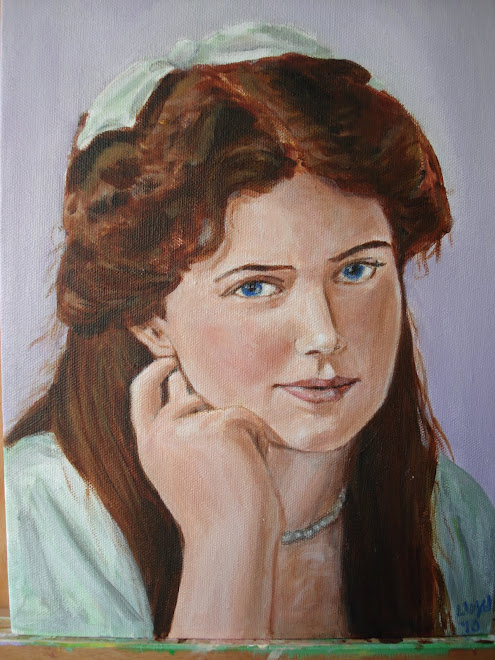

My portrait of Olga Nicolaievna is completed. At the beginning, one never knows how a piece of art will turn out. I am so grateful that this painting turned out as well as it it. Most Romanov enthusiasts have a family member who often calls to them more than the others, almost a special door to the family. For me, and for forty years, that one has been Olga Nicolaievna.
It's not based on any reason ( though there are many) before I could read the family's story, Olga's photo captured my interest. So it's extra meaningful to me that her portrait turned out as it has, really beyond my hopes. As readers of this blog know, I only began seriously painting last year. However I believe what is helping me now as I paint , is many years of sculpting and 40 years of looking at the Romanov photographs I am now painting...oh and Spirit.
One feels that strongly in the studio.
Here is a poem Olga wrote for her mother in the Spring of 1917 . The Russian revolution had happened by then, and the family were prisoners in their own home. Yet this is a hopeful poem that looks to the future. The family still believed they would be sent to England or the Crimea to live .
Olga Nicholaievna to Alexandra 1917
You are filled with anguish For the suffering of others.
And no one's grief Has ever passed you by.
You are relentless Only toward yourself,
Forever cold and pitiless.
But if only you could look upon
Your own sadness from a distance,
Just once with a loving soul -
Oh, how you would pity yourself,
How sadly you would weep.
This is a very heart felt poem with a great deal of wisdom. Based on her life time of observation, Olga points out Alexandra could always give solace to others, but not herself. Giving solace to others is a position of power of course , but seeing your own sadness and weeping about it is not. It's acceptance , something Alexandra certainly struggled with often.
Olga wrote to her Aunt Xenia around this time saying that Alexandra couldn't cope with the new life. So here we see Olga's famous compassion extending to her mother as she urges Alexandra, " Mama, be as kind to yourself as you are to others....for once ".
Olga is also offering Alexandra a way to begin to come to grips emotionally with what has happen. Unfortunately their captivity was so tension and danger filled, I doubt Alexandra could take this advice, even if she would. But it must of felt good to have Olga's love, and understanding so tenderly expressed, and with Olga's usual boldness! She said things to Alexandra no one else would dare.
Here is a letter Olga wrote to her mother in 1918 when the family was separated later in Siberia. One can barely imagine the anxiety of those weeks . Would the two groups even see each other again? They just couldn't know.
------------------------------------------------------------------------------------
2/15 May, 1918.
Tobolsk.
My dear little Mama, Since your birthday, we had no news of you, I mean, that's why we're waiting for some news of you impatiently. And you, do you not receive our letters? We sent, all in all, two telegrams. I'm writing near the wide open window. Today, the weather is splendid; no wind. The little one is out in the garden. They moved him there in his wheelchair. He also got up and put his clothes on yesterday, but he didn't get out.
We also cut some wood, for the bath. Zhillik and Trina had cut it before with the saw. We were on the roof, sleeping under the sun. Yesterday, there was a splendid sunset, and a marvelous evening. It was so luminous, and the sky was filled with stars!. You certainly don't have such a deep silence when the night has arrived...My dearest, how do you live and what are you doing? I would like so much to be with you! We don't know when we'll leave. My little brother must go in the garden more often and regain more strength, then, I think we will be able to leave.
I've sent a card to Kay these days. Today, I got a letter from Trofimov. He salutes you all, and send his regards. He's writing that the little Anatoly, his son, sends his wishes to his "grand-mother". There's a lot of funny couples coming and going in the street, even sometimes on bicycles.
Tell Mashka that I saw N. Dim. and Pimy from afar. We have moved the piano in your lounge, also the couch that was impeding us during Mass. Last night, the fan exploded with a lot of noise, and in our rooms, upstairs, we had no electricity.
I hope that, at least, you get our letters. A strange man has just passed, with a red fez on his head. Well, it's time. May the Lord protect you, my dear Mama, and all of you. I kiss Papa, you and Mashka, I take you in my arms and love you all.
Your Olga.
------------------------------------------------------------------------------------------------ Yesterday, there was a splendid sunset, and a marvelous evening. It was so luminous, and the sky was filled with stars!.
One cannot help but admire someone who has already suffered many months of ever worsening captivity, but who can still remain so responsive to to nature .
You certainly don't have such a deep silence when the night has arrived
This is in reference to the fact that Ekaterinburg , where her parents and Marie had been taken, was a city of 10,000 and Impative House was right in the middle of it . Someone as perceptive as Olga had to know once there, the chances of escape was nil...yet she and her siblings , Tatiana, Anastasia and Alexi rushed to join their parents and Marie as soon as they were allowed.
Meriel Buchannan reports in her fine essay about Olga:
....but a few days later a company of Red Guards arrived, with orders to take everybody to Ekaterinburg. The three Grand Duchesses were overjoyed at the thought of rejoining their parents, and disregarded the warnings of both M. Gilliard and General Tatichtchef, who pleaded that the Tsarevitch was not yet well enough to travel, and tried to delay their departure. Nothing mattered, the Emperor's daughters said, so long as they were all together. Olga Nicholaievna certainly realized their terrible danger, for when on May 20 they started on their journey, she told Baroness Buxhoevenden whose repeated requests to be allowed to join them had now been granted that they were lucky to be still alive, and able to see their parents once more, whatever the future might bring.
Lucky to still be alive...she knew that and lucky the family can even see each other again. Olga knew in the Russia of 1918, these were miracles. But they would be the last.
Meriel Buchannan ends her biographical essay in part with these following words. I can never read them without emotion. When Meriel Buchannan wrote about Olga , it seemed very likely the memory of Olga Nicolaievna Romanova and her short life would be blotted out by the rush of 20th century history.
It moves me how much Meriel Buchannan wants to ensure that will not be the case. This shows the profound effect Olga Nicolaievna had even on those she knew but in passing.
Meriel Buchannan says :
The tragedy of Ekaterinburg has been told before, so much has happened since, and people's memories are short. But because the Grand Duchess Olga Nicholaievna was not known by many, and was loved by all the few who came in contact with her, I have outlined it again very briefly, in the hopes that those who read her story may perhaps remember with pity what was done to her. Not because she was the daughter of an Emperor, and the great-granddaughter of Queen Victoria, but because she was young and gay and gallant, and steadfast until the end.
Indeed she was

Olga Nicolaievna
____________________________________________________________________
and now some Olga anecdotes
"She was an avid reader and a poetess of considerable talent. In spite of the great difference in age Grand Duchess Olga was particularly friendly with my father with whom she felt free to discuss anything that interested or worried her. She said always that my father was 'a deep well of profound ideas,' and even addressed him in all her letters as 'Dear Well.' [...] Olga and I were working seriously on poetry, and the Grand Duchess became interested in my verses. Her interest naturally added more zeal to my endeavors and from then forward I submitted every new piece of verse I wrote to Olga which she analyzed very carefully, often giving me valuable advise, and exchanging opinions about rhymes, rhythms, and other problems which are supposed to preoccupy the poets. Thus it was that I came to know and appreciate fully the fine sensitive character of Grand Duchess Olga."
"Olga was by nature a thinker and as it later seemed to me, understood the general situation better than any member of her family, including even her parents. At least I had the impression that she had little illusions in regard to what the future held in store for them, and in consequence was often sad and worried. But there was a sweetness about her which prevented her from affecting anybody in a depressing manner, even when she herself felt depressed."
Gleb Botkin
------------------------------------------------------------------------------------
One day at In the beginning of June 1914 when I was alone with her she asked me a question with that confident and disingenuous frankness which was all her own, and the legacy of the relations which had been established between us when she was quite a little girl: “Tell me the truth, monsieur: do you know why we are going to Romania?”
In some confusion I replied: “I believe it's a courtesy visit. The Tsar is going to return the visit the King of Romania paid him some time back.”
“Oh, that's the official reason -- but what's the real reason ? I know you are not supposed to know, but I'm sure everyone is talking about it and that you know it.”
As I nodded in assent, she added: “All right! But if I don't wish it, it won't happen. Papa has promised not to make me -- and I don't want to leave Russia.”
“But you could come back as often as you like.” “I should still be a foreigner in my own country. I'm a Russian, and mean to remain a Russian!”
Pierre Gilliard ____________________________________________________________________
In the strict sense of the word, one cannot call her beautiful, yet her being beams with such femininity, such youth, that she seems more than beautiful. The more you look at her, the more charming and appealing her face becomes.
It is illuminated by a light from within, it grows lovelier because of her bright smile and the way she laughs, throwing her head back a little, showing off a whole straight row of pearly snow-white teeth. Her beautiful, gentle hands handle any job with ease and cleverness.
She is so fragile and gentle as she bends with particular love and care over every soldier's shirt that she sews. Her musical voice, her graceful movements, her lovely, thin little figure -- it is the essence of femininity and friendliness. She is so bright and joyful. I remember the words of one of her teachers: Olga Nikolaevna has a crystal soul."
- S. Ofrosimova ____________________________________________________________________
Grand Duchess Olga, the eldest, was more like her mother in character. She was invariably just and honest. [...] As a child Olga was quick-tempered and even difficult. Like her mother, she was obstinate and spoke to your face what she thought, at times quite sharply. With age it smoothed out, and as she grew up, she seemed to become more softer, more tender and sensitive, while retaining the characteristic honesty of her early years. Olga could not be called beautiful, for her features were not regular--her small nose was tilted up, and her mouth was a bit large, but she inherited golden hair, a good complexion, regal bearing and grace from her mother. Olga was the most gifted of the Imperial daughters. She wrote very nice verses, and had musical abilities; she could play by ear the most complicated piece of music, her voice was not strong, but pure. All the teachers were amazed at her memory, which she certainly inherited from her father. Nothing could distract her if she was engrossed in a task, and to her it was enough to read a lesson once or twice as to know it by heart. Like her mother, she was very religious and was inclined to mysticism. She was my favorite."
Anya. Vyrubova ____________________________________________________________________________________ And when younger... _____________________________________________________________
We took the children to a toy shop, and they were told that they might choose what they liked for themselves, and also for relations and friends at home. Olga looked at the things, and finally chose the very smallest she could find, and said, politely, "Thank you very much." Vainly the shop people showed her more attractive toys; she always replied: "No, thank you; I don't want to take it." I took her on one side and asked her why she would not buy the toys. I said that the people would be very sad if she would not take more, and that she could not leave the shop without buying more. So she said: "But the beautiful toys belong to some other little girls, I am sure; and think how sad they would be if they came home and found we had taken them while they were out." I explained to her, and she and Tatiana laid in a large stock
This story links in my mind with an anecdote from so much later, in May of 1918 when Olga her sisters and brother were rejoining their parents and Marie at Ekaterinburg. The ship, the Rus , was being loaded with their luggage. But along with their possessions, other items that did not belong to the family were being loaded as well. Some things had been scooped up from the governors house, but the big item was a horse and carriage on the dock loaned to them by the local bishop because Alexi couldn't walk to the boat. To the soldiers, it did not matter whose it was, everything on the dock was simply swept up into the Rus . But Olga was very distressed that the bishop would suffer for his kindness. These two stories seemed linked in my mind. They show Olga's inborn caring for others and given her station, her extraordinary empathy.
-------------------------------------------------------------------------------------------
In 1902 Alexandra wrote to her husband: „To keep the children quiet, I made them think of things and then guess them. Olga always thinks of the sun, clouds, sky, rain or something belonging to the heavens, explaining to me that it makes her so happy to think of that. _____________________________________________________________
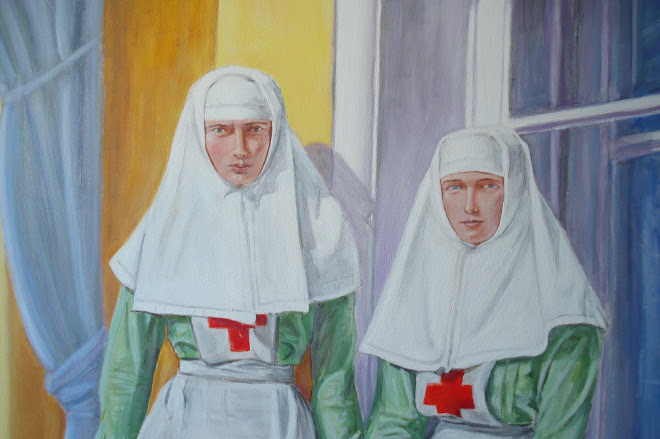
 Here is my earlier painting of the Big Pair in their nurses uniforms. This painting will be included in the upcoming book of selections of Olga's 1913-17 diaries in English, translated by Helen Azar and edited by Raegan Baker. Raegan Baker edited the earlier book of Olga's 1913 diaries.
You can imagine how thrilled I am to have my work included in a volume of Olga's diares.
As always I make a video about my paintings. Here's is Olga Nicolaievna's